

The next time you accuse an LLM of hallucinating, you're accusing the human brain of the same thing. We just don't call it that.
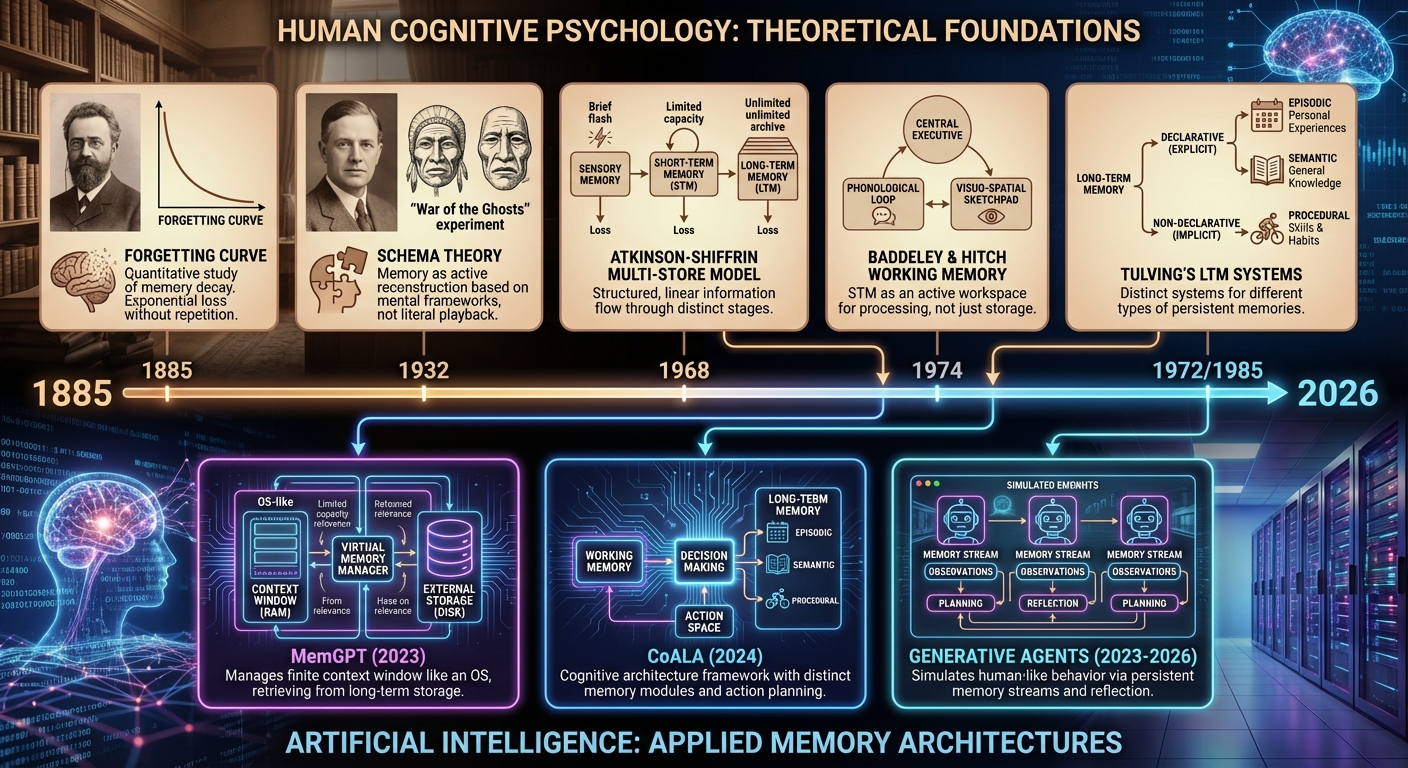
That insight hit me while preparing a talk on memory and state in AI agents — and it fundamentally changed how I think about AI memory and memory architectures. In the first part of this memory series, I walked through the technical architectures — from stateless LLMs to production-ready memory stacks. This article goes one level deeper: 140 years of cognitive psychology, directly applicable to how we equip AI agents with memory.
The opening is deliberately provocative. But it's correct. Let me explain why.
 Figure: From 1885 to 2026 — cognitive psychology and AI memory in historical overview.
Bartlett: Memory Is Not a Recording
In 1932, Frederic Bartlett asked English students to retell a First Nations folklore story. The results were striking: subjects systematically changed the story. Supernatural elements vanished, unfamiliar details got rationalized, and the plot bent toward familiar cultural patterns.
His conclusion was radical for the time:
"Remembering is not the re-excitation of innumerable fixed, lifeless and fragmentary traces. It is an imaginative reconstruction, or construction."
Bartlett (1932)
Memory isn't reproductive — it's reconstructive. We don't store exact copies of events like a recording device. Instead, we encode information relative to existing mental frameworks — Bartlett called them schemas — and reconstruct when we recall, filling gaps with schematic knowledge.
He coined the term "effort after meaning": the active, often unconscious process of connecting new information with existing knowledge to build a coherent story.
Bartlett Explains LLM Hallucination
Why am I telling you this? Because this process is exactly what LLMs do — and what we call "hallucination."
| Bartlett (Human) | LLM |
|---|---|
| Schema-based reconstruction | Reconstruction from statistical patterns |
| "Effort after meaning" — forcing coherence | Generates plausible details for narrative consistency |
| Bias toward the culturally familiar | Preference for high-frequency training patterns |
| Confabulation at knowledge gaps | Hallucination under uncertainty |
The critical difference isn't the process — it's one missing element: reality checks. Humans have perception, senses, embodiment — continuous feedback loops with the physical world that calibrate our reconstructions. LLMs don't.
Hallucination isn't a mysterious AI failure. It's the same reconstructive process as in humans — just without the corrective mechanisms that keep most human confabulations close enough to reality to go unnoticed.
This perspective changes everything. We can reduce hallucination rates through better grounding mechanisms, RAG, and structured outputs. But we probably can't eliminate hallucination as a principle. It's not a bug you can fix. It's a feature of reconstructive information processing.
The Multi-Store Model: Atkinson-Shiffrin (1968)
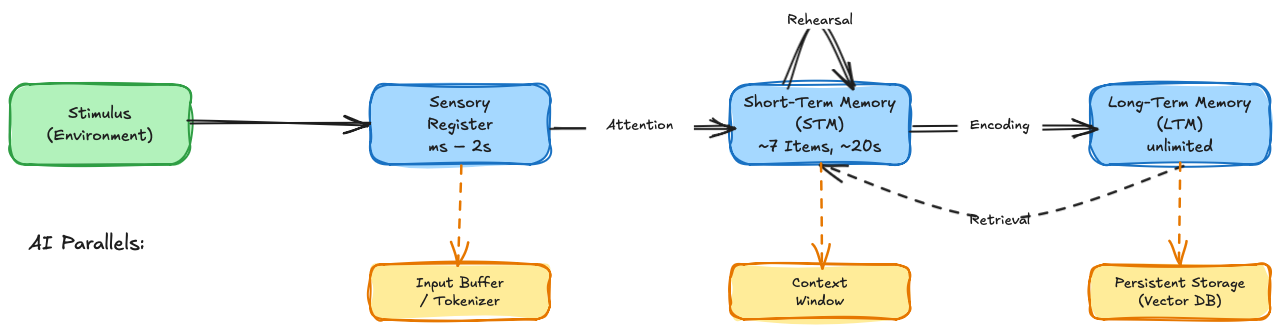 Figure: Sensory Register, Short-Term Memory, Long-Term Memory and their AI equivalents.
36 years after Bartlett, Richard Atkinson and Richard Shiffrin formalized the first complete memory model. Their Multi-Store Model describes three sequential stores:
- Sensory Register — milliseconds to about 2 seconds, high bandwidth, automatic filtering
- Short-Term Memory (STM) — about 7 items (plus or minus 2), roughly 20 seconds without active rehearsal
- Long-Term Memory (LTM) — theoretically unlimited capacity and duration
The key mechanism between STM and LTM is rehearsal — the control process that actively transfers information into long-term storage. Without rehearsal, information is lost.
The AI mapping is direct and almost unsettlingly precise:
| Atkinson-Shiffrin | AI Equivalent |
|---|---|
| Sensory Register | Input Buffer / Tokenizer |
| Short-Term Memory | Context Window (limited, volatile) |
| Long-Term Memory | Persistent Storage (Vector DB, Fine-Tuning) |
| Rehearsal | RAG Loops, Summarization |
MemGPT — now known as Letta — implements exactly this model. Core Memory, Recall Memory, Archival Memory: three layers, straight from Atkinson-Shiffrin. What was described for human memory in 1968 is embedded in one of the most sophisticated AI memory architectures of 2023.
Baddeley: Working Memory as an Active Workspace (1974)
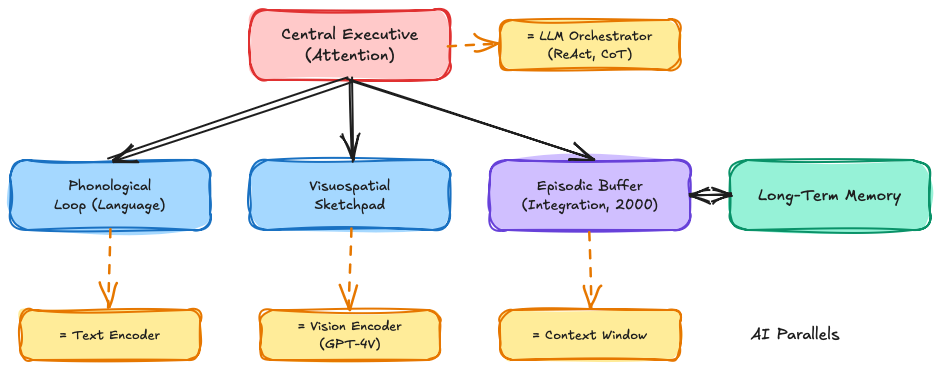 Figure: Central Executive coordinates the Phonological Loop, Visuospatial Sketchpad, and Episodic Buffer — and their mapping to AI agents.
In 1974, Alan Baddeley corrected Atkinson-Shiffrin on a crucial point: short-term memory isn't passive storage — it's an active workspace with a management structure.
Baddeley's Working Memory Model describes:
- Central Executive — The attention control system. It directs focus, coordinates subsystems, manages task-switching. Domain-general, capacity-limited.
- Phonological Loop — Processes verbal and acoustic information.
- Visuospatial Sketchpad — Holds and manipulates visual and spatial information.
- Episodic Buffer (added in 2000) — Integrates information from all subsystems and long-term memory into coherent episodes.
The mapping to AI agents is elegant:
| Baddeley | AI Agent |
|---|---|
| Central Executive | LLM as Orchestrator (ReAct loop, Chain-of-Thought) |
| Phonological Loop | Text processing pipeline |
| Visuospatial Sketchpad | Vision Encoder (GPT-4V, CLIP) |
| Episodic Buffer | Context Window as integration space |
The context window isn't simply "storage." It's Baddeley's Episodic Buffer: the space where RAG results, system prompt, and user input merge into a coherent representation. And the LLM itself is the Central Executive — coordinating tools as "slave systems," exactly as Baddeley described for the human brain.
Tulving: Three Qualitatively Different Memory Systems (1972/1985)
Endel Tulving (1927–2023) asked perhaps the most consequential question in memory research: Is there really one unified long-term memory — or multiple qualitatively different systems?
His answer, developed from 1972 and consolidated in 1985: at least three.
Episodic Memory — Personally experienced events, bound to time and place. "Yesterday at the meeting, Maria said..." Tulving calls the associated awareness autonoetic — the subjective feeling of truly re-experiencing a past event, not just knowing about it.
Semantic Memory — Facts, concepts, meanings, detached from learning context. "Paris is the capital of France." The awareness is noetic — you know something without re-experiencing it.
Procedural Memory — Skills, habits, routines. Riding a bike without thinking. The awareness is anoetic — you can do something without consciously knowing how.
CoALA: Tulving's Taxonomy as an AI Architecture Standard
This is where it gets exciting for AI research. The CoALA Framework (Cognitive Architectures for Language Agents, Sumers et al. 2023/2024, TMLR 2024) — developed at Stanford and Princeton — adopts Tulving's taxonomy directly and without detours:
| Tulving's System | AI Equivalent |
|---|---|
| Episodic Memory | Conversation logs, agent trajectories, interaction records with timestamps |
| Semantic Memory | RAG document stores, knowledge bases, fine-tuning weights |
| Procedural Memory | Model weights (learned skills), tool-use patterns, RLHF policies |
Cognitive psychology from the 1970s flowing directly into an AI architecture standard of 2023. The gap between these fields is smaller than it looks.
Generative Agents: Tulving in Practice (2023)
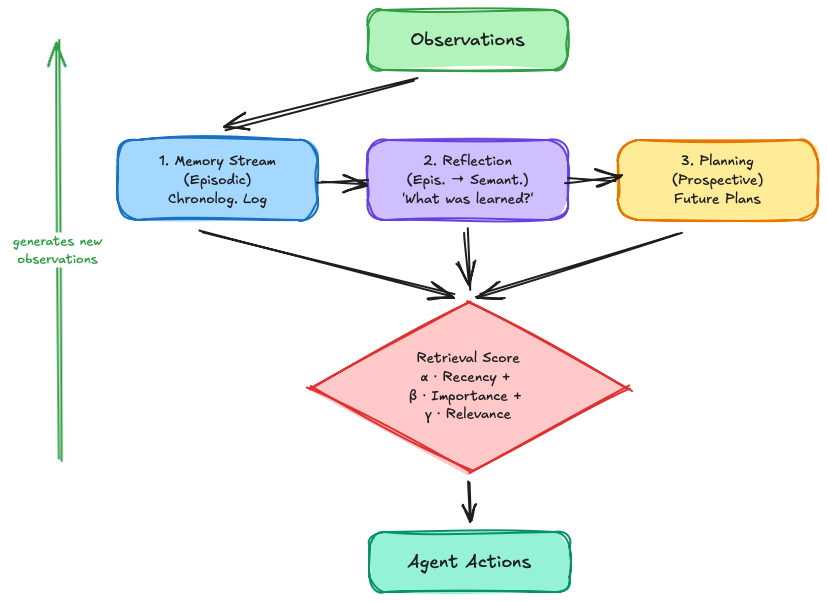 Figure: 25 AI agents in a simulated small town — Memory Stream, Reflection, and Planning implement Tulving's memory model directly.
The most well-known example of Tulving in practice is the work by Park et al. (2023): Generative Agents (UIST 2023). 25 AI agents live in a simulated small town — a kind of AI-powered "The Sims" — with a fully elaborated memory system.
The system has three components that directly implement Tulving:
Memory Stream — A chronological log of all observations. This is episodic memory in its purest form: time-bound events with context.
Reflection — Periodically, agents synthesize their episodes: "What have I learned?" Episodic entries become semantic insights. Exactly the process Tulving describes as episodic-to-semantic consolidation.
Planning — From memories, future plans are derived. More on this in the next section.
Particularly interesting is the retrieval score that determines which memories are recalled at any given moment:
Score = α x Recency + β x Importance + γ x Relevance
This score imitates human memory accessibility: new memories, important memories, and currently relevant memories come to focus more easily. The result: emergent social behavior. Agents organized parties, formed opinions — and remembered each other.
Ebbinghaus: Why AI Forgets (1885)
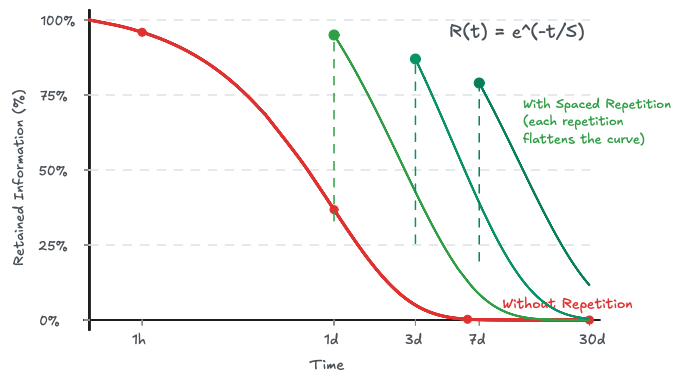 Figure: Exponential forgetting in humans and AI — from Ebbinghaus 1885 to modern catastrophic forgetting strategies.
Hermann Ebbinghaus made himself the experimental subject in 1885. He learned nonsense syllable sequences and systematically measured how fast he forgot them. The result is the first quantitative theory of forgetting: retention decays exponentially:
R = e^(-t/S)
Specifically: about 56% of information is forgotten within one hour, about 75% within six days. But each review session "resets" the curve — with a shallower decay. From this came the principle of Spaced Repetition, now implemented in every serious learning system.
The AI parallels are direct:
| Ebbinghaus Concept | AI Equivalent |
|---|---|
| Forgetting curve | Catastrophic Forgetting — training on Task B destroys performance on Task A |
| Context decay | "Lost in the Middle" — tokens in the middle of the context window receive progressively less attention |
| Spaced Repetition | Experience Replay — periodic re-training on past data |
| Prioritizing important memories | EWC (Elastic Weight Consolidation) — protecting important parameters from being overwritten |
A 2025 paper (arXiv:2506.12034) provides the most convincing empirical confirmation to date: the authors measure recall probability in Multi-Layer Perceptrons via hidden-state similarity to stored prototype representations, then compare the resulting temporal degradation to the Ebbinghaus model. The result is unambiguous: the forgetting curves of the MLPs follow the human pattern closely — steep initial decline, slowdown over time, significant improvement through scheduled reviews (the machine equivalent of spaced repetition). The authors conclude that neural networks represent an architecture that naturally mirrors the dynamics of human memory decay.
That leads to an interesting reframing: forgetting isn't a bug of neural networks that enough engineering could eliminate. It's a fundamental tradeoff between capacity, generalization, and availability — a tradeoff you can manage but not resolve. With that, the Bartlett hallucination thesis gets a counterpart on the forgetting side: forgetting, too, isn't a system error but a feature of learning systems.
Mental Time Travel: Remembering and Planning Are the Same Thing
Tulving's deepest insight comes in 1985 and is further elaborated in 2002: episodic memory enables mental time travel.
- Retrospection — projecting yourself back in time to re-experience past events
- Prospection — projecting yourself forward in time to pre-experience possible future events
The crucial point: the same neural networks — medial prefrontal cortex, precuneus, hippocampus — support both. Memory and planning share a common substrate.
"By mentally playing and replaying past events, as well as constructing and evaluating possible future scenarios, mental time travel allows us to plan for the future in uniquely flexible ways."
Suddendorf & Corballis (2007)
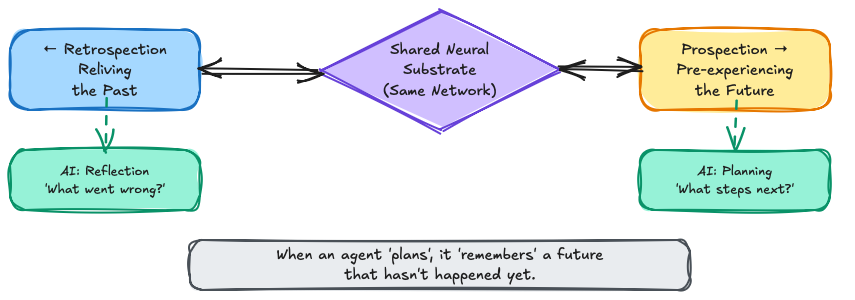 Figure: Remembering and planning use the same neural networks — and in LLMs, the same mechanism.
For AI agents, this is immediately relevant. The same LLM that summarizes past experiences ("What went wrong last time?") also generates future plans ("What steps should I take next?"). The mechanism is identical — just conditioned differently.
When an agent "plans," it's remembering a future that hasn't happened yet. This isn't a philosophical thought experiment. It explains why reflection and planning are so closely linked in agent architectures and why this approach feels so natural: it draws on the same mechanism the human brain has used for millennia.
The three-component system of the Generative Agents — Memory Stream, Reflection, Planning — is thus fully explained by Tulving: retrospection becomes reflection, prospection becomes planning.
What Psychology Can Still Teach Us
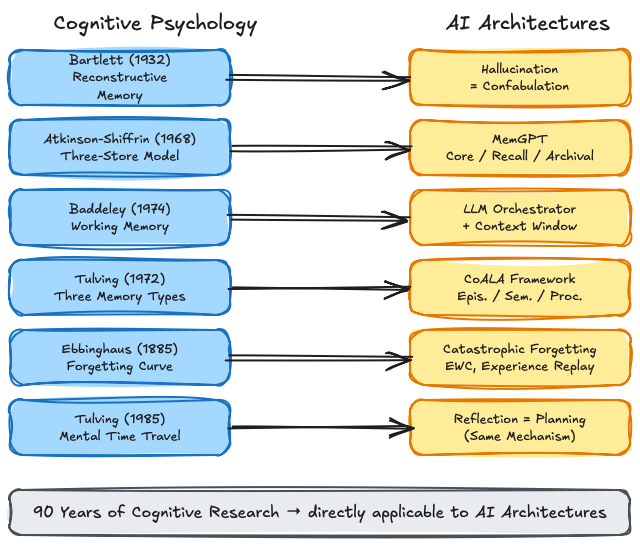 Figure: From Bartlett to Tulving (Mental Time Travel) — six cognitive models and their direct AI equivalents.
Much cognitive research has already flowed into AI architectures. But there's untapped potential that I find genuinely fascinating:
Emotional Salience — Emotional memories are stored more strongly and durably. Could importance-weighted memory systems for agents work similarly? The retrieval score of the Generative Agents has an Importance factor — but what counts as "important" is still determined relatively simply.
Sleep Consolidation — and its AI implementation: "Dreaming". During sleep, the brain reorganizes memories: strengthens important ones, clears redundancies, links related information. In the first part of this series I already teased Auto-Dream as a trend — here comes the full picture, alongside Letta's Sleep-Time Agents.
Letta (the evolution of MemGPT) introduced Sleep-Time Agents: background sub-agents that prune, merge, and refresh memory during idle phases between active sessions. Functionally, that's the same thing as nocturnal memory consolidation — with measurable results: 18% accuracy gain and a 2.5x cost reduction per query. The Generative Agents (Park et al. 2023, see above) already had a reflection mechanism that periodically condenses episodic memories into semantic insights — also a form of consolidation, but inline rather than offline.
Claude Code (Anthropic, 2026) takes it one step further with Auto-Dream. The feature borrows directly from the language of neuroscience and describes itself as an analog to "memory consolidation during REM sleep — the neurological process by which the brain converts short-term experiences into long-term, organized memories". The cycle has four clearly bounded phases:
- Orientation — Claude reads the existing memory structure and the MEMORY.md index file.
- Gather Signal — targeted search for high-value signals (user corrections, save commands, recurring topics), not full transcript reviews.
- Consolidation — relative dates are converted to absolute timestamps, contradictory facts are removed, stale entries are cleaned up, and overlapping notes are merged.
- Prune and Index — the MEMORY.md index is kept below 200 lines.
The cycle runs automatically when at least 24 hours have passed since the last run and more than 5 sessions have occurred. In one tested memory folder, content shrank from over 280 to under 200 lines after a single cycle. For safety, Auto-Dream is read-only with respect to source code and never runs during active sessions; a lock-file mechanism prevents race conditions. As of March 2026, the feature ships behind a server-side flag (tengu_onyx_plover) and hasn't been broadly enabled yet.
The concept builds on UC Berkeley's "Sleep-time Compute" research (2025), which showed that pre-processing during idle phases can reduce inference compute by roughly 5x. The direction is clear: memory consolidation is moving from an optional feature to a standard component.
Self-Search: Retrieval as an Active Tool. Another trend connects directly to cognitive psychology: explicit self-search in one's own history. The Hermes Agent (Nous Research, February 2026) works with a clean split:
| System | Where | Role |
|---|---|---|
| Persistent Memory | MEMORY.md + USER.md | "Frozen snapshot" in the system prompt — ~1,300 tokens, instantly available |
| Session Search | SQLite + FTS5 in state.db | Unlimited, searches all past CLI and messaging sessions |
The documentation puts it precisely: "Memory is for critical facts that should always be in context. Session search is for 'did we discuss X last week?' queries." Via the session_search tool, the agent searches its own past — deliberately, purposefully, on demand. Not automatic retrieval like RAG, but an active retrieval process the agent itself initiates.
Nous Research doesn't claim any cognitive-psychology motivation — the system is built purely for pragmatic reasons. But the parallel forces itself on you: session search corresponds to the deliberate, strategic act of remembering — Bartlett's "effort after meaning", just applied to search rather than reconstruction. The mechanism is radically simple (no vector DB, no embeddings), but conceptually significant: the agent knows that it has a past, and can actively investigate it.
Prospective Memory — "Don't forget to do X tomorrow." Humans are good at setting time-bound reminders for themselves. Timer-based memory triggers for agents would be a direct implementation.
Social Memory — We remember differently in groups: as part of a collective memory, with shared reference points and distributed recall work. How would multi-agent systems remember as a group?
The Mapping Table
Before we get to the open questions, an overview of everything we've covered:
| Cognitive Model | Year | Core Insight | AI Architecture |
|---|---|---|---|
| Bartlett | 1932 | Reconstructive, not reproductive | Hallucination = confabulation |
| Atkinson-Shiffrin | 1968 | Three sequential stores | MemGPT: Core/Recall/Archival |
| Baddeley | 1974 | Active workspace + executive | LLM as orchestrator + context window |
| Tulving | 1972 | Episodic/semantic/procedural | CoALA: 3 memory types for agents |
| Ebbinghaus | 1885 | Exponential forgetting | Catastrophic forgetting, EWC |
| Tulving | 1985 | Mental Time Travel | Reflection = planning |
More than 90 years of cognitive research — directly applicable to AI architectures running in production today.
Open Questions
The exciting questions are the ones cognitive research itself hasn't fully resolved:
Do we need real consciousness for real memory? Tulving says genuine episodic memory requires autonoetic awareness — the self-awareness that distinguishes re-experiencing from mere fact-retrieval. LLMs have no self-awareness. Does that mean they lack genuine episodic memory by definition — or is functional memory that accomplishes the same tasks sufficient?
CoALA offers a pragmatic answer. The framework adopts Tulving's structural taxonomy (episodic, semantic, procedural), but not the consciousness-bound definition. Implicitly, CoALA answers the question with: yes, functional memory is enough — as long as it fulfills the right tasks. An agent that retrieves conversation logs with timestamps and acts on them behaves outwardly like someone with episodic memory, without any subjective re-experiencing. That's elegant, but not free: tasks that require genuine subjective remembering — autobiographical identity coherence, emotional attachment to past episodes — remain in principle out of reach for such systems. The open question isn't answered, but more sharply framed: not "do LLMs have memory?", but "for which tasks is functional memory sufficient, and for which isn't it, in principle?"
Is hallucination solvable — or inherent? If Bartlett is right and memory is fundamentally reconstructive, then confabulation isn't a bug. Can we only reduce the rate, never reach zero? That would have practical consequences for how we design AI systems and what trust assumptions we make.
Who controls the memory? Self-managed memory — where the agent decides what to remember — is the direction research is heading. MemGPT pioneered this. But it immediately raises ethical questions: consent, transparency, right to be forgotten. Do we need "memory governance" for AI systems?
An interesting partial answer comes from Letta itself: on February 12, 2026, Letta announced Context Repositories — a memory architecture for coding agents (Letta Code) that treats agent memory like source code: versioned, branchable, merge-capable. Agent context is stored as files in the local filesystem, every change is automatically versioned via Git with informative commit messages. Where MemGPT manages memory like operating-system memory, Context Repositories extend the analogy with a version-control layer. It's not the answer to "who controls?", but it's a tool for "how do we make control visible?": parallel agent instances work in worktrees, memory evolution is fully auditable, and conflicting memories surface as merge conflicts instead of silent overwrites. Governance starts with observability — and Git-for-memory is a strikingly obvious approach.
Does metacognition emerge from memory? When an agent reflects on its own memories — isn't that the beginning of metacognition? That would be the next level: AI that doesn't just have memory, but evaluates and understands its own memory. I explored exactly that question in a separate article on metacognition and self-learning AI agents.
Conclusion: 140 Years as a Design Resource
Cognitive psychology isn't a historical curiosity. It's a directly usable design resource for AI architectures.
Bartlett (1932) explains why hallucination is inherent. Atkinson-Shiffrin (1968) lives inside MemGPT. Baddeley (1974) explains why the LLM-as-orchestrator pattern works. Tulving (1972/1985) defines the memory types that CoALA implements as an architecture standard. Ebbinghaus (1885) explains catastrophic forgetting and shows why experience replay works.
Understanding these patterns leads to better architecture decisions. Not because AI research consciously copies psychology — but because good solutions to the memory problem exhibit deep convergence, whether implemented in a biological or a digital system.
A question to take with you: does the Bartlett perspective change how you think about hallucination — and if so, what does that mean for the systems you're building or using?
References
- Bartlett, F.C. (1932). Remembering: A Study in Experimental and Social Psychology. Cambridge University Press.
- Atkinson, R.C. & Shiffrin, R.M. (1968). "Human Memory: A Proposed System and Its Control Processes." The Psychology of Learning and Motivation, Vol. 2.
- Baddeley, A.D. & Hitch, G. (1974). "Working Memory." The Psychology of Learning and Motivation, Vol. 8.
- Tulving, E. (1972). "Episodic and Semantic Memory." In Organization of Memory.
- Tulving, E. (1985). "How Many Memory Systems Are There?" American Psychologist.
- Ebbinghaus, H. (1885). Über das Gedächtnis. Duncker & Humblot.
- "Human-like Forgetting Curves in Deep Neural Networks." arXiv:2506.12034 — June 2025.
- Suddendorf, T. & Corballis, M.C. (2007). "Mental Time Travel and the Shaping of the Human Mind." PNAS.
- Sumers, T.R. et al. (2023/2024). "Cognitive Architectures for Language Agents." arXiv:2309.02427. TMLR 2024.
- Park, J.S. et al. (2023). "Generative Agents: Interactive Simulacra of Human Behavior." arXiv:2304.03442. UIST 2023.
- Hu, Y. et al. (2025). "Memory in the Age of AI Agents: A Survey." arXiv:2512.13564.
- Nous Research. "Hermes Agent: Memory." hermes-agent.nousresearch.com
This article was originally published on Medium.